
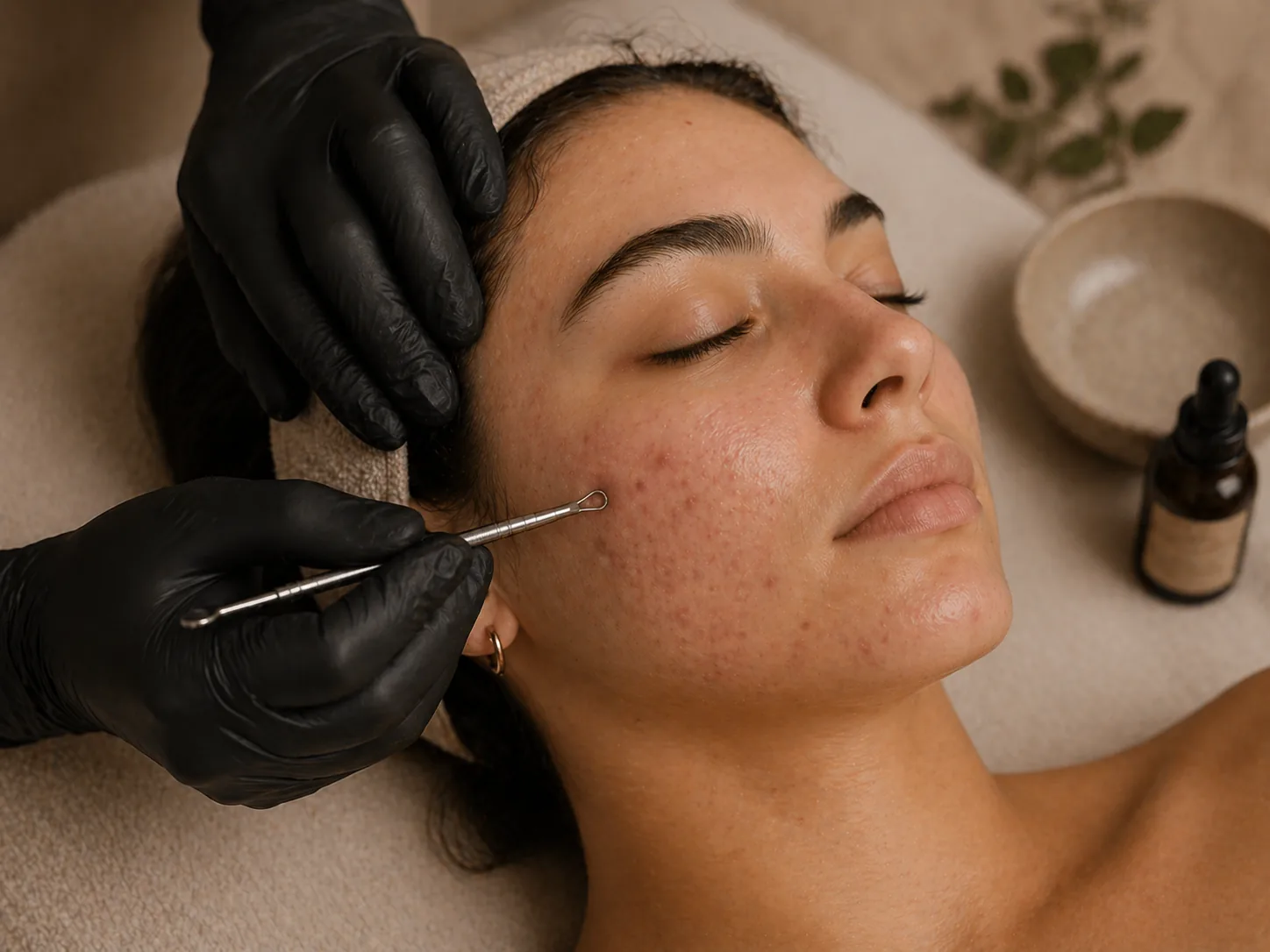
If you're considering acne facials, I'm going to assume you've already tried the over-the-counter route — the spot treatments, the cleansers your friend swore by, the TikTok routine that worked for a week. The clients who come into my Orange, CA studio for the first time usually have a bag of half-used products and a complicated history with their skin.
So this isn't a marketing piece. It's a realistic timeline of what to actually expect once you start booking professional acne facials, written from what I see week after week. Including the part where things look worse before they look better, the month most clients try to quit (don't), and what the milestone moments actually look like.
What an acne facial actually is (and isn't)
An acne facial is a corrective treatment — not a relaxation one. It's designed to do three things: reduce active inflammation, clear congested pores, and interrupt the cycle that produces the next breakout. Every step has a purpose. There's a calming massage, sure, but the protocol isn't optimized for vibes — it's optimized for skin change.
That's the part I have to coach new clients on. If you walk in expecting a spa experience, an acne facial will feel surprisingly clinical. If you walk in expecting clinical results, it's exactly what you booked. We can layer in the spa part once your acne settles down — at that point, our signature facial becomes the right fit for maintenance.
What happens during a session
A typical acne facial at MASHMEOVER runs 60–75 minutes. The protocol changes slightly for different acne grades, but the core steps are:
- Skin analysis under a magnifying lamp. I want to see what kind of breakouts you have (comedones, papules, pustules, cysts) and where they cluster. That maps the rest of the session.
- Double cleanse. Oil-based first to dissolve sebum and makeup, water-based second to lift the surface debris.
- Enzyme or salicylic exfoliation. Loosens the dead skin cells trapping congestion. Salicylic is oil-soluble — that means it actually gets into the pore where acne lives.
- Steam and warm towels. Softens the skin and opens pores for extractions. Skip this for rosacea-overlap or very inflamed skin.
- Extractions. The part everyone's curious (and nervous) about. Done correctly, it's not painful — controlled pressure with sterile tools, focused on what's actually ready to release. We don't dig.
- High-frequency or LED light therapy. Blue LED kills Cutibacterium acnes (the bacteria that drive breakouts); red LED calms inflammation. Both are non-invasive.
- Calming mask and finishing serum. Reduces redness, restores hydration, supports the moisture barrier so the next 24 hours are gentle.
You leave with a face that's slightly pink and noticeably calmer. The next morning is usually the moment where you go "oh, this is different."
The realistic results timeline, week by week
Acne doesn't clear in a straight line. Here's the version I tell every client at intake.
Week 1: visibly calmer, not yet clearer
The 48 hours after your first facial are the calmest your skin has felt in months. Active inflammation is reduced, blackheads and surface congestion are gone, and the underlying redness has come down. The cysts you came in with are still there, but they're noticeably less angry. This is the win that hooks people.
By day 5–7, some new breakouts may surface. Don't panic — this is normal. Your skin is processing the exfoliation and pulling deeper congestion to the surface. These new spots heal faster than the ones you had before.
Week 2: the first plateau
If you booked your second facial at the 2-week mark (which we'd recommend for active acne), week 2 is when the second round of extractions clears more underlying congestion. Some clients see a small purge between sessions — usually a cluster of small bumps in your normal breakout zones, not anywhere new.
Week 3–4: pattern shift
This is where most people first notice the bigger pattern. New breakouts are smaller. They heal in 2–4 days instead of 7–10. You're not waking up to a fresh cyst every other morning. The post-acne marks from previous breakouts are starting to fade because the inflammation that drives hyperpigmentation has settled down.
Week 6: the moment most clients stop quitting
By week 6 the math has clicked. You've had 3 facials, the worst of the breakouts are gone, and you can predictably tell your skin "I'm going to do this thing tomorrow" without spiraling about a sudden pimple. This is also the milestone where I push members to keep going — week 6 is when the discipline pays off, but it's not the destination.
Month-by-month: where clients usually are at 1, 3, and 6 months
Month 1
Inflammation under control. Most active breakouts are smaller and resolve faster. Skin is noticeably less reactive to products and food. Post-acne marks are slowly fading. You've had 2–3 facials at this point, depending on cadence.
Month 3
This is where the bigger transformation shows. New breakouts are uncommon — usually only around hormonal cycles. The post-acne hyperpigmentation has faded by 30–50%. Skin tone is more even. Texture is smoother. We can now safely introduce more aggressive treatments — light chemical peels or BioRePeel — to start addressing the marks and texture left behind. Cadence usually shifts from biweekly to monthly here.
Month 6
For most clients on a consistent protocol, month 6 is "I forgot I used to have acne." Active breakouts are rare and quickly handled. Texture is smooth. The clinical work transitions from corrective to preventive. Some clients drop to every-6-weeks maintenance; others stay monthly because they like how their skin looks. This is the point where the membership math really pays off — predictable cadence at a lower per-treatment cost.
Month 3 is where most clients underestimate how much progress they've made — and overestimate how much they still need. Compare your face today to a picture from your first appointment. The shift is bigger than the bathroom mirror gives you credit for.
Purging vs. breaking out — they're different
This is the conversation I have most often. Here's the difference.
Purging is normal. It happens in your usual breakout zones (forehead, chin, jaw if that's where you break out), it's a wave of smaller bumps that move faster through their lifecycle, and it settles within 4–6 weeks of starting any new active treatment — including acne facials, retinols, or peels.
Breaking out from a product or process means your skin is reacting badly. It shows up in new areas (where you don't normally break out), looks angry and inflamed, includes itching or burning, or doesn't resolve over time. That's not purging — that's irritation, and we need to back off and reassess.
If you're not sure which one is happening, text us a photo before your next appointment. We'd rather adjust the protocol than have you white-knuckle through a reaction.
How often to book and why cadence matters
Cadence is half the result with acne facials. Here's what I generally recommend for clients in Orange, CA:
- Moderate-to-severe active acne: Every 2 weeks for the first 4–6 weeks. Then re-evaluate.
- Mild active acne: Every 3 weeks for the first month, then monthly.
- Hormonal cyclical acne: Monthly, timed to the week before your cycle hits.
- Post-acne maintenance (no active breakouts): Every 4–6 weeks, often combined with peels or LED for fading marks.
The reason cadence matters: acne is a cycle, not a single event. The American Academy of Dermatology describes acne treatment as a process that needs at least 4–8 weeks of consistency before you can fairly judge whether something is working. Facials work the same way — one treatment is a snapshot. Three is a trend. Six is a transformation.
Ready to actually fix it?
Book an acne facial at our Orange, CA studio. We'll do a full skin analysis and build the protocol around your specific breakouts — not a one-size-fits-all template.
Book an Acne FacialStack the results: peels, LED, and at-home routine
Acne facials work, but they work better stacked. Here's what we usually layer on top.
Light chemical peels (month 2 onward)
Once active inflammation is controlled, a salicylic or lactic chemical peel accelerates post-acne mark fading and prevents the next cycle. We typically alternate with regular facials — peel every other month.
LED light therapy as an add-on
Blue LED kills surface bacteria; red LED calms inflammation. Both are non-invasive and add no downtime. We include LED in every acne protocol and can extend the session for stronger results. You can also book standalone LED light therapy in between facials.
The at-home routine that doesn't sabotage progress
The biggest failure mode for acne facials is great in-spa work paired with bad at-home habits. Per the AAD's acne skincare guidelines, the basics that matter most are: a gentle non-comedogenic cleanser twice a day, a lightweight non-comedogenic moisturizer, broad-spectrum SPF every morning, and hands off the face. We'll customize a routine for your specific skin at your second visit.
What acne facials can't fix on their own
Acne facials are powerful, but they're not magic. Here's where I'm always honest:
- Severe cystic acne — facials reduce flare frequency but don't replace medical treatment. For deep, painful, scarring acne, see a dermatologist alongside our work.
- Hormonal acne driven by medical conditions — PCOS, thyroid imbalances, and similar root causes need medical workup first. Facials help, but the root cause is upstream.
- Acne caused by medication — corticosteroids and certain birth controls can cause persistent breakouts. We can manage the surface, but the root is the medication.
- Pre-existing scarring — facials prevent new scars and fade pigmentation, but textural scarring usually requires deeper resurfacing protocols (peels, microneedling, sometimes laser).
If any of these apply to you, we'd build a hybrid plan — work with your dermatologist on the medical side and run facials on the skincare side. The two reinforce each other.
Booking, prep, and aftercare for Orange CA clients
If you're ready to book, here's what to expect on your end.
Before your appointment
- Come without makeup if you can. If you can't (Orange County workdays are real), we'll cleanse on arrival — just budget the extra 10 minutes.
- Skip retinol, AHA, BHA products for 3 days before. They overlap with what we'll be doing in-spa.
- Don't pick at home in the 48 hours before. Anything already open is harder to extract safely.
- Bring a list of products you currently use, plus any oral medications. It helps us understand what's interacting with your skin.
After your appointment
- Hands off for 6 hours. Touching the extraction sites is the fastest way to introduce bacteria.
- Skip the gym, sauna, and steam for 24 hours — sweat into open extraction sites is asking for trouble.
- No retinol or acids for 48 hours.
- SPF 30+ every morning. Acne-prone skin is extra vulnerable to post-inflammatory hyperpigmentation, so sun protection is non-negotiable.
- If new breakouts surface in the next 7–10 days, don't panic. Document them. We'll review at your next session.
To book, visit Vagaro or call (714) 809-2851. If you're a member of our Skin-scription program, your acne facials are included at the lowest rate — which makes the every-2-weeks cadence sustainable. For first-time visitors, ask about the intro pricing when you book.