
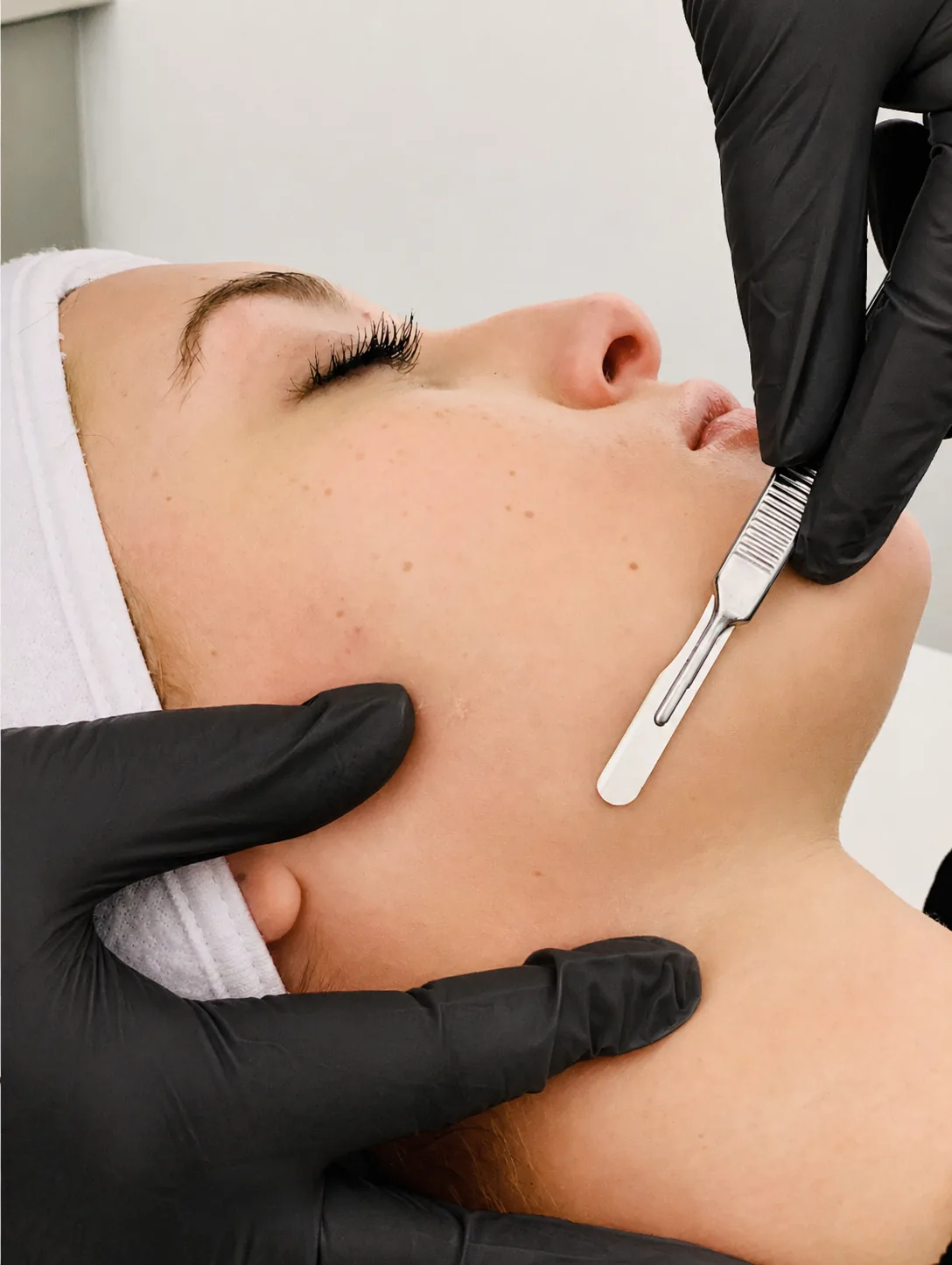
I get a version of this question almost every week at the Orange, CA studio: "Is dermaplaning actually worth it, or is it just a trend?" Fair question. Beauty TikTok has hyped dermaplaning hard for years, which means some clients show up expecting magic, and others show up convinced it's overpriced shaving.
Ready to book a dermaplane facial?
See pricing, membership options, and book online at our Orange, CA studio.
See Dermaplane Service & Pricing → Book OnlineThe honest answer is somewhere in between. Dermaplaning is one of the most reliable, no-downtime treatments we offer — but only for the right person, at the right cadence, in combination with the right other services. This guide walks through who actually benefits, who should pass, and how to know which side you're on.
What dermaplaning actually is
Dermaplaning is a manual exfoliation treatment that uses a sterile surgical blade — held at a precise angle — to remove the outermost layer of dead skin cells and the fine vellus hair (peach fuzz) on your face. No chemicals, no heat, no abrasive particles. Just a steady hand and a sharp blade.
The clinical term for the procedure is "dermaplaning," but per the Cleveland Clinic, it falls under the broader category of physical or mechanical exfoliation. It's different from microdermabrasion (which uses crystals or a diamond tip) and different from a chemical peel (which uses acid). All three exfoliate — they just use different tools.
At MASHMEOVER, we use single-use sterile blades, treat the face only (no nose, no eyelids, no lip line), and complete the treatment in 20–30 minutes — either as a standalone dermaplane facial or layered into a custom protocol.
What dermaplaning does for your skin
Three things, primarily:
- Removes the outermost dead skin layer. This is the stratum corneum — the buildup that makes skin look dull, makes makeup cake, and slows down your skincare's penetration. Manual exfoliation clears it in a way no cleanser or scrub can match.
- Removes vellus hair. The fine "peach fuzz" on your face traps oil and dead skin and reflects light in a way that softens contrast. Removing it makes skin look brighter, and makeup applies dramatically smoother — no more foundation catching on tiny hairs.
- Improves product absorption. Anything you put on your skin in the 24–48 hours after dermaplaning penetrates more effectively. A serum that normally sits on the surface actually gets where it's supposed to go.
The visible result is what I call the "FaceTime glow." Skin reflects light differently. Texture is smooth. Makeup looks like it costs twice as much. The effect lasts about 3–4 weeks before the dead skin and peach fuzz fully return.
The "hair grows back thicker" myth, busted
This is the question I answer most often. Let me put it firmly to rest.
Dermaplaning does not make hair grow back thicker, darker, or coarser. Vellus hair grows back at the exact same diameter, texture, and color as before. The blade cuts the hair at the skin's surface — it doesn't touch the follicle, which is what determines what kind of hair you grow.
The myth comes from how the hair feels in the first week after dermaplaning. Your peach fuzz naturally has a tapered tip — soft and feather-light at the end. When the blade cuts it, the regrowth has a blunt tip for a brief period, which feels slightly rougher to the touch even though it's the same hair. Within a few weeks, the hair tapers naturally again. Nothing has changed.
If you don't believe me, this is the most well-documented topic in cosmetic dermatology — every reputable medical source, including the American Academy of Dermatology, confirms that shaving and similar mechanical hair removal does not alter the follicle. It's biology, not branding.
Who dermaplaning is for
Most adults benefit from dermaplaning. The ideal candidate has any combination of:
- Dull or rough skin texture that doesn't respond to at-home exfoliants
- Noticeable peach fuzz that affects makeup application or how light hits the face
- An event coming up — wedding, photoshoot, party, anything where the FaceTime glow matters
- Sensitive skin that can't tolerate chemical exfoliation
- An interest in product absorption — anyone using high-end serums or retinols will get more from them post-dermaplane
- Skin that's been stuck at a plateau — sometimes mechanical exfoliation breaks through where acid couldn't
For first-time visitors, we often pair dermaplaning with a signature facial so it doubles as both an exfoliation treatment and a relaxation visit.
Who should skip dermaplaning (or postpone it)
This is the part most "is dermaplaning worth it" articles skip. Here's the honest list:
- Active acne — especially cystic, pustular, or open lesions. The blade can spread bacteria across the face and worsen breakouts. We'd run an acne treatment series first and circle back to dermaplaning once the active inflammation is under control.
- Active cold sores or herpes simplex flares — same reason. Any open lesion is a no-go.
- Severe rosacea flares — the friction of the blade can trigger more redness. Mild or controlled rosacea is usually fine; active flares aren't.
- Hirsutism or PCOS-related terminal facial hair — dermaplaning targets vellus hair, not coarse terminal hair. If you have darker, thicker facial hair, you'd be happier with laser hair removal or threading.
- Within 14 days of a chemical peel or retinoid spike — the skin is already turning over rapidly. Stacking dermaplaning on top can compromise the barrier.
- Within 48 hours of a sunburn — wait until the skin is healed.
If any of these apply, we'd start somewhere else. There's almost always a treatment that fits where your skin is today.
How often you should book it
Every 4 weeks is the standard cadence, and the math behind it is your skin's natural cell turnover cycle. Roughly 28 days for healthy adult skin; slower as you age, faster in your 20s. Dermaplaning every 4 weeks works with that cycle instead of against it.
- Every 3 weeks: for clients who want the glow to never dip — usually monthly members or people in high-visibility roles.
- Every 4 weeks: the sweet spot for most people. Glow refreshes right before the previous one wears off.
- Every 6 weeks: lighter maintenance, common for clients who alternate with chemical peels or hydrofacials.
- Less than every 6 weeks: works as event prep but you won't get the compounding glow benefit.
If you want the cadence handled automatically and at the lowest per-treatment cost, our Skin-scription membership includes monthly dermaplaning options.
Curious which treatment you actually need?
Our 60-second "Which Facial Is Right For Me" quiz routes you to the right starting protocol — dermaplane, hydrofacial, peel, or signature. Or just book straight to Vagaro if you already know.
Book a DermaplaneThe stacks: dermaplane + peel, hydrofacial, LED
This is where dermaplaning becomes genuinely powerful. Solo, it's a great refresh. Stacked, it's the multiplier.
Dermaplane + HydroFacial
The most-requested combo at our Orange, CA studio. Dermaplane first to clear dead skin and peach fuzz, then HydroFacial to deep-clean pores and infuse serums. Because there's nothing in the way, the HydroFacial serums penetrate deeper than they otherwise would. The glow is next-level.
Dermaplane + Chemical Peel
For clients targeting tone, texture, or hyperpigmentation. Dermaplane removes the surface layer so the chemical peel acid penetrates more evenly. Only safe with superficial peels (glycolic, lactic, mandelic at lower concentrations) — not medium or deep peels.
Dermaplane + BioRePeel
The no-downtime power combo. Dermaplane first, BioRePeel immediately after. Medium-peel results without visible flaking, with the added smoothing of dermaplaning. We see this combo booked heavily before weddings and big events.
Dermaplane + LED
For sensitive or rosacea-prone skin that wants the dermaplane glow without inflammation risk. LED light therapy calms post-dermaplane redness and adds collagen-stimulation benefits.
What the appointment is actually like
Your first dermaplane appointment runs 45–60 minutes total. Here's the flow:
- Consultation (5–10 min): Quick skin analysis, conversation about goals and concerns, blade-safety check.
- Cleanse: Thorough double cleanse to remove all makeup, oil, and SPF.
- Skin prep: A pH-balancing toner so the blade glides smoothly. Your esthetician dries the skin completely — dermaplaning is done on dry skin.
- The dermaplaning itself (15–25 min): Your esthetician holds the skin taut and uses the blade in small, controlled strokes across your face. There's no pain — it feels like having your face dusted with a paintbrush. You'll hear a faint sound that some clients find oddly satisfying.
- Soothing serum and mask: A hydrating or calming serum followed by a brief mask while your skin acclimates.
- SPF and finish: Mandatory SPF, even if you're going home and not back outside. Fresh skin is UV-vulnerable.
The first time you see your face right after dermaplaning, it looks like someone added a filter. The blade just removed the layer that was muting your features.
Aftercare — and what to skip for 48 hours
Dermaplaning has no real downtime, but the 48 hours after matter.
- SPF 30+ every morning. Non-negotiable. Fresh skin is significantly more UV-sensitive.
- Skip retinol, AHA, and BHA products for 48 hours. Your skin just had a deep exfoliation — let the barrier rebuild before adding more actives.
- Skip aggressive cleansers, scrubs, and facial brushes. Stick with gentle cream cleansers until your next cleanse cycle.
- Hydrate. A hyaluronic serum and a ceramide moisturizer work overtime here. Skin will drink in whatever you put on it.
- Skip the gym, sauna, and steam room for 24 hours. Sweat into freshly exfoliated skin can trigger small breakouts.
- Avoid waxing, threading, or hair removal in the treatment area for 5–7 days.
- Don't touch your face. Sounds obvious, but the smooth feeling is addictive. Your hands carry bacteria that just-treated skin doesn't need.
The honest answer: is it worth it?
If you're in the "right candidate" category and you book it at the right cadence — yes, dermaplaning is one of the better dollar-for-dollar treatments in esthetics. Real results, no downtime, immediate visible difference. For event prep or a regular maintenance routine, it earns its slot in the menu.
If you're hoping it'll solve acne, deep wrinkles, scarring, or melasma — no, it won't. Different problem, different treatment. You'd be better served by an acne facial series, a chemical peel protocol, or BioRePeel depending on the specific concern.
Most clients in Orange County who come to me for dermaplaning end up keeping it as a regular part of their routine — usually once every 4–6 weeks, often paired with one other service. The compounding glow over a few months is what hooks them. If you're on the fence, book once and see how your skin responds. If it does what you're hoping, we'll build a cadence. If it doesn't, there's no harm done and we can re-route to something that fits better.
Ready to try? You can book a dermaplane facial on Vagaro or by calling (714) 809-2851. If you're not sure whether dermaplaning or something else is right for you, take the facial-matching quiz — it'll point you the right direction in about 60 seconds.